In the
Catholic faith (and probably other Christian denominations), there are seven
sacraments that mark different significant stages of a follower’s life and
commitment to the Church. The seven sacraments (in relative chronological
order) are: Baptism, First
Reconciliation, First Communion (aka First Eucharist), Confirmation, Marriage, Holy Orders, and Anointing of the Sick.
In brief, here is what each sacrament represents:
- Baptism: initiating someone into the Catholic club as an “official” member
- First Reconciliation: helping Catholics seek healing for their sins by confessing to their priest (who is believed to act as a representative of God)
- First Communion: initiating someone even further into the Catholic club by letting them partake of the body and blood of Christ
- Confirmation: finalizing the initiation of someone into the Catholic club by having them reconfirm their commitment
- Marriage: strengthening the Catholic club by having two of its members enter into a holy commitment to one another
- Holy Orders: strengthening the Catholic club by having one of its members (read: men only) commit to God by becoming a priest, deacon, or bishop
- Anointing of the Sick: helping Catholics seek healing for their ailments by being blessed by a priest (who is believed to act as a representative of God)
Now, if you’re like most Catholics, you got baptized when
you were a baby and had no choice in the matter, you made your First Reconciliation
in second grade when the worst sin you ever committed was calling your sister
the b-word, you made your First Communion also in second grade when you barely
knew what being Catholic meant, and you did Confirmation in middle school just
before your critical thinking and decision-making skills kicked in. If you’re
like me, you never made it past First Communion, and your mother cried bitterly
for your lost soul when you told her you weren’t going to be confirmed. That’s
right, I am one of those former Catholics who hasn’t gone through all the
sacraments, but I have some interesting memories about the ones I did
experience.
As I said, I was baptized Catholic as a baby, so I have no
memory of it and did not contribute to that fairly major life decision
whatsoever. My mom grew up Catholic and remains a strong devotee today, while
my dad grew up Lutheran and agreed to become Catholic after marrying my mom. My
parents (mostly at my mom’s demand) enrolled me in Catholic schools growing up,
so the sacraments were built into my educational experience, and I didn’t need
to attend Sunday School. I recall taking First Communion classes in second
grade with Mrs. Knievel at St. Anthony’s Catholic School in Casper, Wyoming (and
yes, she was related to well-known
stuntman Evel Knievel through marriage—only in Wyoming!). I remember the parish’s
priest came by occasionally to tell us about what the sacrament meant and
answer any questions we had. He told us that when we eat the bread (which is
really just a little silver dollar-sized wafer with less flavor than a saltine)
and drink the wine (which is really real wine if you’re Catholic, not the Welch’s
grape juice that those Protestant heathens give their seven-year-old children!),
you are genuinely eating the body and blood of Christ. One of my less abashed
classmates asked, “But isn’t that weird to eat and drink Jesus?” To which the
priest replied, “No, that is what Catholics believe.” As solid an answer as that
was for children at whose age the question “But why?” is compulsive, I somehow had
a follow-up question. “So, the bread and the wine are symbols for the body and
blood of Christ?” (Ok, ok, so it might not have been that articulate in my
second-grade dialect, but it was something along those lines…) “No!” the priest
forcefully dissented, “once they are blessed, they are truly the body and blood
of Christ!” For real, folks, it’s called “transubstantiation,” and it’s actually
what Catholics believe. To most, it is nutty at best and cannibalistic at
worst. To me, it really never made sense, and I never actually bought it.

Nevertheless, like a good little Catholic girl, I completed
my First Communion, with my pure, lacy white dress and shiny, white Mary Jane shoes.
The day of one’s First Communion is sort of a mini-holiday for Catholics, where
everyone dresses up and you are showered with gifts by approving Catholic
relatives. My mom gave me a pair of teeny tiny gold star earrings with little
diamonds in the middle for my freshly pierced ears, and I can honestly tell you
that I still have them to this day and wear them on occasion. My grandma gave
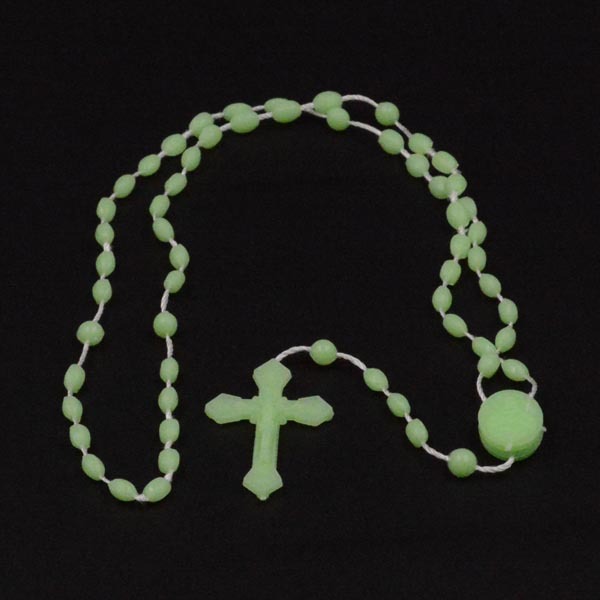
me a glo-in-the-dark rosary, so I could say my Hail Mary’s and Our Father’s
with a little extra pizzazz. Mrs. Knievel gave me a laminated scapular, which
is basically two thumbnail pictures of Mary and/or various saints that are
laminated and tied together with what looks like a run-of-the-mill shoestring.
It is meant to be draped over your shoulders and worn proudly with your First
Communion attire.
When it comes to taking the body of Christ, the traditional
way of doing it was to stick out one’s tongue and wait for the priest or Eucharistic
minister to gently place it there. My mom told me that was weird, though, so I opted
for the modern approach of cupping my hands together neatly in front of my
chest and feeding it to myself like someone who’s not a lazy slob. However, it
took me a while to figure out how to deal with consuming the wafer in the few
seconds it takes to walk up to the wine bearer, so as not to backwash Christ into
the community cup. After a few times of awkwardly chewing it before sipping the
wine and, as a result, holding up the line, my mom scolded, “You just let it
disintegrate at the back of your tongue! Just take the wine while it’s still in
there!” I didn’t know what disintegrate meant, but I got the gist.
My First Reconciliation came during the same year, and I’m
pretty sure it actually happened first (it’s all a holy blur). I remember receiving
lessons in class about what it means to be absolved of your sins and being
instructed to think of some sin ideas for my first time. I wasn’t a perfect
child, but I really had to dig deep on that one. Should I tell the priest about how I read my sister’s diary? No, too
personal. How about how I neglected to actually clean my little brother when I
bathed him? Nah, too juvenile. Maybe I can tell him about how I refuse to help
my mom empty the wastebaskets sometimes, even though she tells me it’s “my job”.
Man, this is harder than I thought. I need to start sinning more!
I don’t remember what sins I finally arrived at for the real
deal, but I do remember going into the sacrament with a paralyzing fear that
the priest would find me a complete monster and chastise me in front of the
whole congregation. You see, in movies they always show confession happening in
those private confessionals, where a dark screen separates the sinner from the
priest, offering at least the shroud of anonymity. But in reality, those fancy
confessionals are rarely used in modern times; instead, most churches have
opted for a quick and dirty face-to-face confession which only happens in a
private room if you’re lucky, but more often occurs right in the main aisles of
the church with nothing but a courtesy space bubble and some ambient hymns to
protect you. You have to whisper your sins to the priest and hope the next
sinner doesn’t overhear, and you better damn keep it brief! I was surprised to
find that after confessing my not-so-deep, not-so-dark sins, the priest simply
said, “Be nice to your family and say three Hail Mary’s.” Phew! That was easy.
I diligently took out my fluorescent rosary when I returned to the pew and said
my three Hail Mary’s stat, clutching one bead for each. I proudly informed my
parents that my first confession went well, and I received minimal punishment.
Then I posed for some awkward family photos in a very early 90s floral print dress with a giant white, triangular bib at the top and my toothless smile. I felt so
relieved that, after a few days' grace period, I went right back to sinning
again.

Well done, Daughter, and more than a little humorous. By the way; while this blog progresses, I think it important to remind you of what your father believes: You were baptized the moment you were born, because like all of us, you are a child of a Higher Power, however He or She may be attempted to be defined. Because of your infancy, at best your parents may restate their belief and ask their Higher Power to protect and guide you as well. Your sins were forgiven the first time you ever sincerely apologized to your Higher Power. As for communion and the rest of the sacraments, and rather than plague you with ideas we have discussed many times, suffice it to restate my general opinion: 1. Humans in a perceptual, empirical world can never completely know or understand something or Someone from a spiritual world. 2. No human is infallible...far from it. 3. Religions, sacraments, traditions, and mysticism are man made, and therefor fallible, if not "weird". Lastly, most religions like to emphasize that their god is all-powerful, all-knowing, etc., and I believe this of my Higher Power. But then they throw things in like "jealous", "angry", "vengeful", etc...poppycock! I'm supposed to believe that the entity that knows no time or boundary, that knows everything that ever happened and already knows everything that ever will happen, is somehow going to be surprised, jealous, angry, etc. about something that occurs or something that a fallible human does, or does not have the power to change what angers or disappoints. The problem is the lack of emphasis that religions give to other aspects of my Higher Power; such as all-loving, all-forgiving, all-compassionate. The presence of these qualities make anger and vengeance an impossibility, and oh by the way, make sacraments, rituals, and rules things made for humans, right or wrong, and not my Higher Power. With that, Daughter, I drop the mike and step down from the soap box!
ReplyDeleteYou know I like to throw in a little bit of deprecating humor! In reality, though, I am not bitter about being baptized and raised Catholic. I was for while, but that angst has passed, and now I appreciate it for what it was. That will hopefully become apparent in later posts in this "series." You know we both generally agree on most aspects of religion and spirituality. I recognize that sacraments and other elements of religion are human creations that attempt to bring people closer to god and their spiritual beliefs, and I don't fault that. They can be somewhat ridiculous sometimes, though, and I find it entertaining to reflect upon and dissect them!
DeleteVery entertaining; and it's okay to find much of this ridiculous, because we humans are often pretty ridiculous. I don't resent catholic rites either, or those of any religion...if it gets people where they need to be, then great! For me though, I find so much of it complicates and makes mystical what otherwise can be so beautifully simple. That is why I always have to follow the same rule about any religion or spirituality: "Take what you can use well and agree with, and politely, respectfully leave the rest".
Delete