Wednesday, July 5, 2017

Some People Like Arts and Crafts...I Have Anxiety

If there’s anything worse than dealing with chronic anxiety, it’s being diagnosed with an anxiety disorder. Like, by a medical professional. Officially. To be clear, I have not officially been diagnosed with an anxiety disorder…or at least, not directly. Let me explain. Like many other adults in the 21st century, I have occasionally sought out mental health counseling to help manage stress, anxiety, a little depression, and just the reality of living as a full-time working adult in an overstimulating modern world. After a few visits with a therapist, I was reviewing the after-visit summaries she had typed up and printed out for me after each appointment, and towards the bottom of the page, the following words jumped out at me: “Diagnosis: Generalized Anxiety Disorder”. Wait, what? This therapist had never verbally diagnosed me with anything, so why would she feel the need to include this on my after-visit summary? At first, I brushed it off, and a few hours later, I promptly stuffed the document into my cross-cut shredder because I was so unexpectedly indignant about it. Who is she to “diagnose” me with an anxiety disorder? What, after a few 45-minute therapy sessions, she thinks she knows me?

Being the reasonably emotionally intelligent person that I am, I caught my defensiveness and thought, well maybe it’s true, and maybe it’s not such a bad thing. Millions of people have anxiety disorders, so it’s not like this makes me some kind of freak. And anxiety issues run in my family, so is this really so novel? And, hey, it helps to explain some of the symptoms I’ve been experiencing for so long, which I can’t seem to shake no matter what self-help methods I try. It’s actually quite freeing, really, to finally know what’s wrong with me. Right?

And then, like a yoyo, my reason gave way to defensiveness once again. If I really have an anxiety disorder, why wouldn’t she have told me to my face? It must have been a mistake or just some formality in the mental healthcare system to show that I’ve been “taken care of” or a ploy to get me to keep coming back for bi-weekly visits at $20 copays a pop. What a racket. Before I could explore the “diagnosis” any further, that particular therapist switched to another clinic, and I was assigned a new one. The new therapist wasn’t a particularly good fit, and I started to feel that the cost and hassle of the sessions weren’t worth what I was getting out of them, so I stopped going.

In retrospect, I think what bothered me so much about this supposed diagnosis was being labelled someone with “Generalized Anxiety Disorder”. Although one of the primary reasons I started going to counseling was to get help with my anxiety, something about anxiety being described as a core part of my being, my biology—and a disordered one at that—suddenly made me feel like a victim. I knew it was something that hindered my everyday existence, from a young age, but I never really saw it as something I was stuck with. I always maintained a belief (or delusion?) that it was a temporary problem that would eventually go away under the right circumstances with the right behaviors. I didn’t like the idea that I was now a member of the millions of Americans with a diagnosed mental health disorder. I couldn’t even bring myself to identify with the label because of how stigmatizing it felt, so I distanced myself from it entirely.

The interesting thing is, I have never been one to demean or marginalize folks with mental health issues. As I said, it’s something that runs in my family, something that has gained increasingly wide-spread recognition in our culture, and something that I know is extremely common, albeit often hidden. I also pursued an education in the social sciences, which exposed me to a great deal of learning about mental illness, sparking a personal interest in going to grad school for counseling. Ultimately, I decided the profession would be too emotionally draining for me, so I pursued education instead. Ironically, much of my exposure to mental health issues has arisen from my work in education, so I guess the joke’s on me.

The difference between my understanding of mental health problems and facing my own is that the former allowed me to view the phenomenon as an outsider, an objective observer analyzing something from a purely academic point of view. The latter forced me to analyze the essence of myself and my own life’s potential. I guess had always subliminally believed that being educated about mental illness and wanting to avoid it would vaccinate me from ever having to experience it. I guess I was wrong.

That being said, I still take issue with the idea of identifying as someone with a mental health disorder. I simply don’t want to incorporate that into my self-image because I feel that it does nothing to help me overcome the challenges I face. Instead, it makes me feel resigned to fulfill the prophecy of the diagnosis and blame it for all my woes—to play the mental illness card, so to say. This makes me feel conflicted because I know that, for many, being diagnosed with a mental health disorder is the first step in seeking treatment and healing for what can be a debilitating daily existence. I also know that naming mental illness has done a great deal of good for our society, which previously ignored it at best and demonized it at worst. I acknowledge that everyone deals with mental illness in very personal ways, despite its prevalence, and I in no way wish to dictate how anyone should feel about it or identify with it.

For me personally, however, I choose to view it as something that I’m dealing with, just like some people deal with social awkwardness or perfectionism. It’s a part of my personality, and yes, a part of my chemical make-up that is probably largely genetic. But as long as I can find ways of managing it and still living a fulfilling life, why does it need to be a disorder? For example, I realized that drinking coffee every morning made me more anxious, especially in situations where I needed to perform (work presentations, speaking in meetings, meeting new people, etc.), so after doing that for several years, I decided to switch to tea instead. For about the first week, the drop in caffeine intake made me feel like a zombie, but eventually my body adjusted, and I realized I felt much less anxious than before. I also go to a primary care provider who recommends more naturopathic remedies before resorting to more synthetic ones. She suggested I try taking a tablet of L-Theanine (the natural ingredient in green tea) whenever I’m feeling a little wired or obsessive, and it actually kind of works. In terms of behavioral or environmental remedies, I finally admitted to myself that a full-time career in which I talk to people all day long and frequently deliver group presentations was just not sustainable or fulfilling. This took some time to accept because there were other aspects of my work that I really enjoyed, and people often told me that I was good at it and encouraged me to advance. Choosing a different pathway felt like giving up. But now that I’m in a role that involves more behind-the-scenes work, I feel so much less dread when I wake up in the morning and so much less drained at the end of each day. Harnessing my social anxiety has been a gnarlier beast, but I’ve been making improvements there too. I realized that putting myself in social situations where I have to meet a lot of new people at once and/or perform propel me to use alcohol as a means of calming my nerves and being a more authentic version of myself. While I don’t believe that occasional escapism or moderated indulgence is a bad thing, I don’t want to feel frequently beholden to them. I less frequently put myself in these kinds of social situations, and I try to maintain friends who fully accept me for who I am and don’t make me feel like I need to perform.


I’m not going to sugarcoat it—all of the above changes and remedies have not cured my anxiety. I still encounter it every day, and it still brings me discomfort, insecurity, and isolation. I’m sure that I will always have these challenges, as I pretty much always have in my life thus far. But addressing my anxiety as an inherent trait that I must accept and continually work on has been a lot more productive and liberating than addressing my anxiety as a disorder that I must medicate and continually keep at bay. Again, different people will choose different methods for managing anxiety, and I acknowledge that some have much more severe forms of it than I do. As long as people are doing what they need to do to feel healthy and happy, more power to them. I just want to offer an alternative perspective that you may just be kind of an anxious person by nature—it’s a small part of who you are, not what you are. Some people like arts and crafts…and I have a little anxiety. And life goes on. 

Image may contain: 1 person, standing, mountain, sky, outdoor and nature

Wednesday, March 30, 2016

Growing Up Catholic: The Sacraments

In the Catholic faith (and probably other Christian denominations), there are seven sacraments that mark different significant stages of a follower’s life and commitment to the Church. The seven sacraments (in relative chronological order) are: Baptism, First Reconciliation, First Communion (aka First Eucharist), Confirmation, Marriage, Holy Orders, and Anointing of the Sick. In brief, here is what each sacrament represents:

  •  Baptism: initiating someone into the Catholic club as an “official” member
  •  First Reconciliation: helping Catholics seek healing for their sins by confessing to their priest (who is believed to act as a representative of God)
  • First Communion: initiating someone even further into the Catholic club by letting them partake of the body and blood of Christ
  • Confirmation: finalizing the initiation of someone into the Catholic club by having them reconfirm their commitment
  • Marriage: strengthening the Catholic club by having two of its members enter into a holy commitment to one another
  • Holy Orders: strengthening the Catholic club by having one of its members (read: men only) commit to God by becoming a priest, deacon, or bishop
  •  Anointing of the Sick: helping Catholics seek healing for their ailments by being blessed by a priest (who is believed to act as a representative of God)

Now, if you’re like most Catholics, you got baptized when you were a baby and had no choice in the matter, you made your First Reconciliation in second grade when the worst sin you ever committed was calling your sister the b-word, you made your First Communion also in second grade when you barely knew what being Catholic meant, and you did Confirmation in middle school just before your critical thinking and decision-making skills kicked in. If you’re like me, you never made it past First Communion, and your mother cried bitterly for your lost soul when you told her you weren’t going to be confirmed. That’s right, I am one of those former Catholics who hasn’t gone through all the sacraments, but I have some interesting memories about the ones I did experience.

As I said, I was baptized Catholic as a baby, so I have no memory of it and did not contribute to that fairly major life decision whatsoever. My mom grew up Catholic and remains a strong devotee today, while my dad grew up Lutheran and agreed to become Catholic after marrying my mom. My parents (mostly at my mom’s demand) enrolled me in Catholic schools growing up, so the sacraments were built into my educational experience, and I didn’t need to attend Sunday School. I recall taking First Communion classes in second grade with Mrs. Knievel at St. Anthony’s Catholic School in Casper, Wyoming (and yes, she was related to well-known stuntman Evel Knievel through marriage—only in Wyoming!). I remember the parish’s priest came by occasionally to tell us about what the sacrament meant and answer any questions we had. He told us that when we eat the bread (which is really just a little silver dollar-sized wafer with less flavor than a saltine) and drink the wine (which is really real wine if you’re Catholic, not the Welch’s grape juice that those Protestant heathens give their seven-year-old children!), you are genuinely eating the body and blood of Christ. One of my less abashed classmates asked, “But isn’t that weird to eat and drink Jesus?” To which the priest replied, “No, that is what Catholics believe.” As solid an answer as that was for children at whose age the question “But why?” is compulsive, I somehow had a follow-up question. “So, the bread and the wine are symbols for the body and blood of Christ?” (Ok, ok, so it might not have been that articulate in my second-grade dialect, but it was something along those lines…) “No!” the priest forcefully dissented, “once they are blessed, they are truly the body and blood of Christ!” For real, folks, it’s called “transubstantiation,” and it’s actually what Catholics believe. To most, it is nutty at best and cannibalistic at worst. To me, it really never made sense, and I never actually bought it.


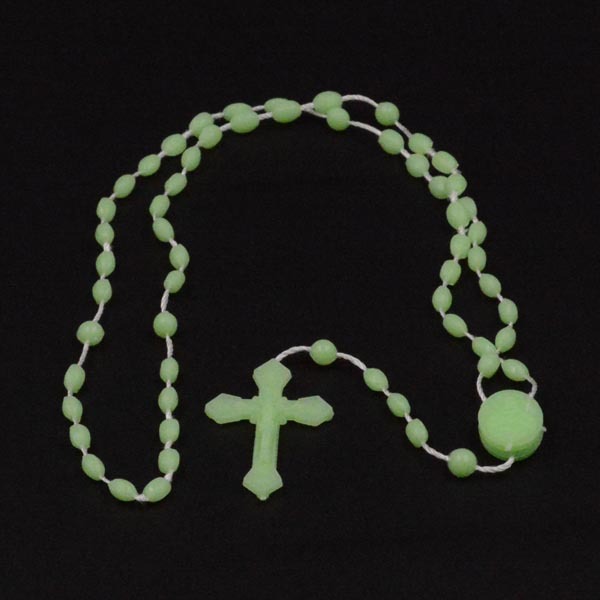
Nevertheless, like a good little Catholic girl, I completed my First Communion, with my pure, lacy white dress and shiny, white Mary Jane shoes. The day of one’s First Communion is sort of a mini-holiday for Catholics, where everyone dresses up and you are showered with gifts by approving Catholic relatives. My mom gave me a pair of teeny tiny gold star earrings with little diamonds in the middle for my freshly pierced ears, and I can honestly tell you that I still have them to this day and wear them on occasion. My grandma gave me a glo-in-the-dark rosary, so I could say my Hail Mary’s and Our Father’s with a little extra pizzazz. Mrs. Knievel gave me a laminated scapular, which is basically two thumbnail pictures of Mary and/or various saints that are laminated and tied together with what looks like a run-of-the-mill shoestring. It is meant to be draped over your shoulders and worn proudly with your First Communion attire.

When it comes to taking the body of Christ, the traditional way of doing it was to stick out one’s tongue and wait for the priest or Eucharistic minister to gently place it there. My mom told me that was weird, though, so I opted for the modern approach of cupping my hands together neatly in front of my chest and feeding it to myself like someone who’s not a lazy slob. However, it took me a while to figure out how to deal with consuming the wafer in the few seconds it takes to walk up to the wine bearer, so as not to backwash Christ into the community cup. After a few times of awkwardly chewing it before sipping the wine and, as a result, holding up the line, my mom scolded, “You just let it disintegrate at the back of your tongue! Just take the wine while it’s still in there!” I didn’t know what disintegrate meant, but I got the gist.

My First Reconciliation came during the same year, and I’m pretty sure it actually happened first (it’s all a holy blur). I remember receiving lessons in class about what it means to be absolved of your sins and being instructed to think of some sin ideas for my first time. I wasn’t a perfect child, but I really had to dig deep on that one. Should I tell the priest about how I read my sister’s diary? No, too personal. How about how I neglected to actually clean my little brother when I bathed him? Nah, too juvenile. Maybe I can tell him about how I refuse to help my mom empty the wastebaskets sometimes, even though she tells me it’s “my job”. Man, this is harder than I thought. I need to start sinning more!


I don’t remember what sins I finally arrived at for the real deal, but I do remember going into the sacrament with a paralyzing fear that the priest would find me a complete monster and chastise me in front of the whole congregation. You see, in movies they always show confession happening in those private confessionals, where a dark screen separates the sinner from the priest, offering at least the shroud of anonymity. But in reality, those fancy confessionals are rarely used in modern times; instead, most churches have opted for a quick and dirty face-to-face confession which only happens in a private room if you’re lucky, but more often occurs right in the main aisles of the church with nothing but a courtesy space bubble and some ambient hymns to protect you. You have to whisper your sins to the priest and hope the next sinner doesn’t overhear, and you better damn keep it brief! I was surprised to find that after confessing my not-so-deep, not-so-dark sins, the priest simply said, “Be nice to your family and say three Hail Mary’s.” Phew! That was easy. I diligently took out my fluorescent rosary when I returned to the pew and said my three Hail Mary’s stat, clutching one bead for each. I proudly informed my parents that my first confession went well, and I received minimal punishment. Then I posed for some awkward family photos in a very early 90s floral print dress with a giant white, triangular bib at the top and my toothless smile. I felt so relieved that, after a few days' grace period, I went right back to sinning again. 

Wednesday, February 10, 2016

Things I Want for My Future Daughter

There will be lots and lots and lots of women on TV, movies, magazines, billboards, and music videos with bodies that look like hers and are simultaneously portrayed as beautiful.

This is about the best we have right now, am I right ladies?
The modern-age propaganda that Botox and fillers and plastic surgery will make her feel better about herself and, somehow, empowered is pathetic. She will know her natural self is her best self.

She can be an engineer, a doctor, a business owner, or a computer programmer, but if she decides to be a teacher, an administrative assistant, a model, or a stay-at-home mom, the value of her labor and her human worth are the same.

She doesn't have to feel guilty about speaking her mind, having a strong opinion, or likewise questioning her ideas and admitting her areas of ignorance. Furthermore, her male counterparts will do the same.


Image result for ok to admit you're wrong

She'll never have to hear comments like these from strangers on the street: "Smile for me, girl, or I'll tug on them cheeks and make you do it." And then actually feel obligated to do so.


She will be taught how to do things like checking her car battery, fixing stuff around the house, starting a campfire, and cooking out on the grill.

She will feel empowered that her body is her own and is powerful, capable, normal, human, beautiful, functional, unique, and so much beyond merely sexual.

Showing her emotions is a powerful and brave thing that everyone should admire.

She is not responsible for always bringing in baked goods, planning a party, or organizing a card for all the office birthdays...unless she really wants to.


She can be straightforward and confident in her speech without worrying about being a bitch.

Any partner who makes her feel unhappy is not a partner she is obligated to stay with. She will know that she can and will do better.

If someone interrupts her or undermines her knowledge repeatedly, she can stop being polite.


the-grinder  fox maya rudolph the grinder grinder

If she loves cats, she's a frickin' normal human, not a crazy hording spinster. 


She is not responsible for more than roughly half of the domestic labor in her household.

She is entitled to generous paid parental leave, as is her partner. "When was that ever not a thing?" she'll wonder.

No matter what her genitalia looks like or who she is attracted to, she has my unconditional love and affection.

Even though she is multiracial and of partially Asian heritage, she isn't "exotic" or someone's fetish. She is a normal human being.

Taking time to be alone rather than with friends, family, or the public is not selfish. She deserves it.


Saying no without qualifying it is not selfish. She has that right.

There will have been at least one female President of the United States already in office, so she'll know women can hold down the most powerful leadership position in the world. No prob. "Mom, why were there so many old white guys for so long?" she'll ask.

Now, I invite my readers to write in your own wants for your future (or existing!) daughter in the comments!

Monday, October 5, 2015

un hommage à l'oignon

Parents of Multiracial Baby Proud of Their Creation

Tukwila, WA--Local parents, Jeanine Goddard, 32, and Ahn Tran, 34, are delightfully satisfied with the multiracial specimen they've created. When the two got engaged in 2010, they were nervous about the prejudice they might face as an interracial couple, especially among the older generations in their conservative families. But now that they have just welcomed their first child into the world, their fears have been assuaged by the many positive compliments received by family, friends, and random strangers about their multiracial offspring's cuteness.

"When the cashier at Safeway assured me that mixed babies are the cutest kind of baby, I knew I had made the right choice to reproduce," said Goddard, visibly proud of her accomplishment. According to Tran, Goddard's Vietnam-born husband, "Friends shower us with compliments about its almond-shaped eyes and adorable freckles, saying it could be a model someday with such an 'exotic' look."

While enjoying the attention they have garnered with their first piece of progeny, Goddard and Tran are already receiving demands from coworkers, community members, and childcare workers to produce a multiracial sibling. "I can't wait to see what the next one looks like! More Asian or more white? It's like the Magic 8 Ball of baby making!" commented an unknown passerby, stroking child number one's hair.

The happy new parents never could have imagined such a positive response, given their own families' homogeneous blood pools. Affirmed Goddard, "It almost makes up for my grandma's deriding comments that our baby looks 'totally Asian'." 

Friday, October 2, 2015

My Response to Gun Violence in America


My reaction to this latest incident in the epidemic of mass shootings in America is disgust and outrage. When I first started to hear about mass shootings, especially school shootings, as a kid, I remember being very shocked, fearful, sad, and confused. I didn’t understand why anyone would want to do that, and my focus was mostly on the killers—trying to analyze their mental state and motivations. I also felt empathy for the victims and their families, as well as fear that something similar could happen to me or someone I know. As I got older and these massacres became more frequent, I grew less shocked, but the other strong emotions persisted. Now that there have been at least 3 school shootings in Pacific Northwest communities with which I’m familiar—including my own—in the past year alone, I feel intense anger that nothing significant is being done to prevent this from happening over and over again. People naturally still ask the question, “Why did this happen? What compelled him to do this?” But frankly, does it matter? Whether it’s depression, schizophrenia, racism, misogyny, or religious discrimination, nothing justifies the selfish act of murdering innocent people. Nothing justifies the ridiculous fact that it is possible and oftentimes easy for individuals to inflict this kind of violence in our country. 

As one of my colleagues said, and as President Obama encouraged in his reaction speech, I intend to make sure that whoever I vote for in the next presidential election is someone who has a clear and outspoken plan about how to address the problem of gun violence. Of course, mental illness and institutional bigotry are also important contributors to this problem, and it’s also a priority for me to elect someone who address those issues with practical and intentional measures. But I feel that access to deadly weapons is a more immediate gateway to mass violence that cannot be ignored any longer. 

Aside from the outrage I feel, I also have noticed my fear increase. I used to be able to distance myself somewhat from these incidents since they didn’t happen to me or anyone I knew personally. This is no longer the case. Their frequency, compounded with the fact that I spend more than 40 hours of each week at a college, have led me to realize I easily could be a random victim of gun violence, as could any of my colleagues, students, or friends. More than once, I have had the thought, “What if today is the last day of my life?” Almost daily now, I pass by a male stranger on campus and feel the burn of cortisol and fear in my chest, wondering, “Does he have a gun in his backpack? Does he look like the type of guy that would shoot up the school? Wait, is there even a certain ‘type’ of guy that does that, or could it be any guy?” Images of him lashing out at me race through my mind in the few seconds it takes to pass by him, and I wonder how I will defend myself if I even have the chance. After hearing the news of the shooting at UCC last night, Sol told me I have to be careful when I’m at work—that he wouldn’t know how to live without me. Though knowing his words came from a place of love, I could only state bluntly, “There is nothing I can do. Anyone can bring a gun to the college and start shooting.” 

Having fears of random strangers pulling out a gun and shooting me or wondering if today is the last day of my life seems irrational and melodramatic. Or at least, at one point in time it would’ve seemed irrational and melodramatic. But these days, it seems like just a natural response to the pervasive threat of violence that exists in our country. It exists for everyone that spends any amount of time in public, open spaces. It exists more so for people of color, women, trans people, gay and lesbian people, and religious minorities. And yet, despite this constant threat, we somehow compartmentalize the violence. One of the most disturbing and frustrating aspects of mass shootings for me is the regimented public response that always occurs in its wake. Again reflecting President Obama’s remarks, I too find it sickening that the media, politicians, and general public offer up their thoughts and prayers for a week or so and then return to their normal lives without looking back. I get it, though, it’s hard not to be numbed by such violence when it happens so often. That is, unless you are one of those directly affected, in which case you are likely re-victimized over and over again with each incident and each routine response. 

I refuse to discontinue empathy for the victims of these atrocities, and I refuse to view the latter as just unfortunate tragedies. Somehow when I hear people use well-intentioned words and phrases like “tragedy” and “sending my love and prayers,” I have a visceral reaction of disempowered exasperation. “Tragedy” seems to imply a sad event that couldn’t have been avoided. “Sending my love and prayers” seems to be a vocalization of dismissiveness. Further, how can anyone view this problem as a non-political one? How can anyone not be enraged? This is what true empathy is: feeling what those directly affected are feeling, not just sending thoughts and prayers from a distance. And this is what politics really are: an organized response to personal and collective pain and passion. 

Let’s empathize. Let’s politicize. Let’s get angry. And for the love of humanity, let’s please change something.

Tuesday, June 2, 2015

A Note to Folks Who Don't Respond

We’re all busy. I get it. There are constant demands for our attention, and in the age of technology and rapid communication, those demands are ever-persistent and ever-increasing. The emails pile up, the text messages mount, the junk mail keeps coming, the voicemails ring in, the Facebook invitations beckon, and the face-to-face requests can’t be ignored. It is frustrating to be inundated with such constant communication, especially if you are an introvert like me, and it sometimes feels like privacy is a commodity as precious as gold itself.

But the bottom line remains that ignoring people—especially those whom you care about and those to whom you are accountable—is, always has been, and always will be disrespectful. I’m not going to launch into some diatribe about etiquette. I may come from a Catholic, Midwestern-reared family that values “nice,” but I’m no bourgeois debutante trying to preserve a stale and superficial version of class. To me, responding to people is about acknowledgment, gratitude, and respect. That is the foundation of my position.

I’m not going to lie, I have a bit of a history with feeling ignored. I grew up a middle child, and while many stereotypes about my birth order are downright unfair, being the one who garners less attention is pretty true. I have also always been an introvert, and a shy one at that, so standing out in social situations has never been my strong suit. As a shy introvert, you often dread being the center of attention but resent not receiving the acknowledgment you often deserve. Insert a dozen other significant life experiences, and voila, I probably have some kind of deep-seated complex about being ignored that Freudian psychotherapists would feast upon.

Be that as it may, I feel I am not alone in noticing that responding to communication—especially that of the non-face-to-face variety—seems to be considered optional these days. Coworkers routinely dismiss or delete important emails and fail to respond even after multiple follow-ups. Employers rarely ever do applicants the courtesy of a “Dear Jane” letter if the latter aren’t selected for an interview. Friends would rather avoid acknowledgement of social invitations than commit to so much as a “maybe.” Customer service representatives delete voicemails if they don’t want to investigate the answer.  Birthday wishes, cards, and gifts go unthanked because they were expected and/or forgotten. The list goes on.

I think we’ve all been on both sides of these experiences at one point or another. Sometimes it’s an honest mistake. We had 57 new emails in our inbox that day, intended to respond, but got distracted by the other 56 and just totally forgot. We were on the hiring committee, saw hundreds of applications come through, and decided to focus our time and effort on selecting candidates. We appreciated our friend’s invitation to hang out but didn’t really feel like it and had no other excuse to offer up, so we felt ignoring the request was gentler than saying no or lying. We were that customer service representative who had just had the week from hell, and one more complicated issue from a demanding and perhaps rude client would bring us to untimely self-destruction. We got inundated with birthday wishes because we’re so darn loved and lost track of who we needed to thank. All these things happen sometimes. But that doesn’t mean they should become our auto-responses.

Think of how you have felt when on the receiving end of utter dead air. What are some emotions or reactions that come to mind? Frustrated? Unimportant? Dismissed? Undervalued? Unresolved? Unappreciated? Confused? The brief quarter I spent in my basic counseling skills class would tell me that all those feelings boil down to raw anger, anxiety, and sadness. Yeah, that’s right, I’m bringing in the heavy stuff! When we fail to respond to one another, regardless of our intentions, we send the message that those who are trying to communicate with us are not important or valuable enough. We send the message that even a 2-minute follow-up is more than we are willing to give. We send messages that cause others anger, anxiety, and sadness. If it is truly the case that we don’t value them, then so be it. But I think more often than not, we do value those people, we do think they are important. However, our actions do not match our intentions.

So, I’m just going to put this out there to any and all who are reading this and who see me as valuable and important in their lives. If I am communicating with you in any medium, give me a response. It doesn’t have to be immediate. It doesn’t have to be long. It doesn’t have to be agreeable. It can be honest, no insincere pleasantries needed, as long as you’re not a jerk about it. But please just give me a response. And if you forget to respond or have more pressing matters at hand, I will understand and will forgive you. But if it becomes a pattern (and trust me, this middle kid notices!), I will question your respect for me and the quality of our relationship. I don’t think I can be more raw than this. I just want your response, a.k.a. your respect.

Some people may think my expectation of a response is coming from a place of entitlement. And to that I would say, it is. I believe we are all entitled to be acknowledged by one another, especially by those whom we care about and those who are accountable to us. We are all also entitled to privacy and are allowed to respond in ways that we see fit. And ok, if I am totally harassing you beyond reason, you have my permission to ignore me. (But I won’t do that, so…nonissue.) I just firmly believe that we can do better. We can do better for ourselves, we can do better for others, and we don’t have to settle for a culture of disengagement. 

As Ellen Degeneres would say, “Be kind to one another.”


Sunday, May 3, 2015

21 Things Former Poor Kids Know About

If you grew up poor or on the lower end of the socio-economic chain, then you can probably relate to these experiences...

1. Lunchables, Pop Tarts, or snack items in the “fun size” pack were rare luxuries. That one scene in Napoleon Dynamite was so true! 

2. Going to summer camp was not a thing for you. reaction animated GIF

3.Having a parent at every sports game, performance, or school event was also not a thing for you.
 forever-alone-movie-gif


4. You got a family computer and a personal cell phone several years after everyone you knew. And then you had dial-up internet for several years after that. 

5. Your mom (or dad, or other guardian) had a healthy stash of coupons and wouldn’t shop without them.
  

6. At least some of your clothes came from Goodwill, Value Village, Salvation Army, garage sales, or an older sibling. You were hipster before it was cool. 

7. You were a latchkey kid and were really creative about entertaining yourself for hours at a time. Ice skating around the living room? On it. Making ramen for dinner? No problem! Playing in the street unattended? Why not! eating animated GIF

8. You felt like royalty when you went to a friend’s house that had more than one floor.


9. You never really understood why some people had home security systems. If someone had broken into your home, they probably would’ve been like, “Thanks anyway…”. ill-pass-gif

10. You ran errands by yourself and babysat younger siblings when you were about 8 years old (or younger). But hey, you were an expert on stranger danger! home alone animated GIF

11. At least someone in your family lived in a trailer park. And that’s an understatement.
 movie animated GIF

12. Having sleepovers at your home was an extremely stressful prospect. panic animated GIF

13. You had traumatizing experiences at shady Medicaid-approved dental and medical clinics. You’re not an expert or anything, but…pretty sure that constituted torture. screaming animated GIF

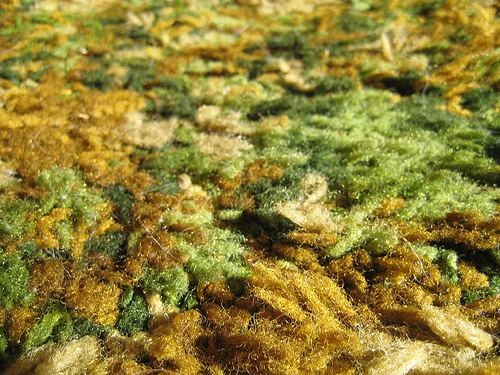
14. Your home’s carpets were a carryover from the 1970s in shades of dark brown, olive green, or marigold yellow shag. The cabinets and furniture were equally retro. 

15. You were well-acquainted with the “value menu” at fast food chains. Getting a combo meal was kind of a big deal. 

Tyler animated GIF

16. The YMCA or community center in your neighborhood was totally your spot. 

17. Most people have “that one family member” that they don’t talk about. Yeah, you have a few…
 quiet animated GIF

18. You were a pro at navigating public transportation well before it was the “green” thing to do.
 Cheezburger animated GIF

19. You thought skiing, surfing, golfing, playing tennis, and other bourge-y sports were just fun things to watch on the Olympics. Then you realized somewhere along the line that real people do those things for fun. And then when they asked if you wanted to come, you were like...
happy endings animated GIF


20. You are not only familiar with free and reduced lunch, but you probably also know what free and reduced breakfast is. But, dang, that oatmeal was delicious! Awe Chris Farley ;)

21. If you were lucky, you learned pretty early on that money doesn’t buy happiness. You figured out how to find it elsewhere. :)food, music, panda, pleasures, sleep